
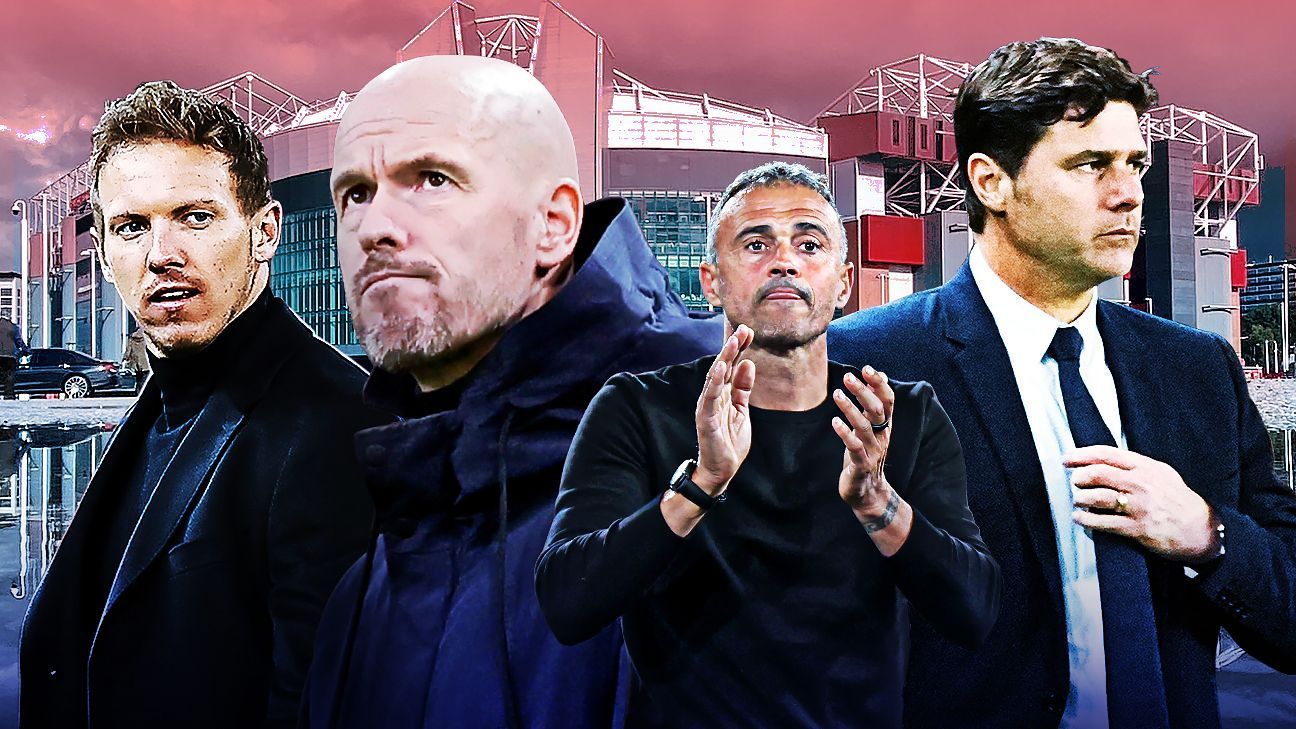
Who should manage Man United? Here's the best overall fit
Man United are way behind their rivals and can't afford to get their next managerial choice wrong. We've done the work and picked the best candidate.
So how should this Man United team play, anyway?
This one larger question can be answered by asking two smaller questions.
The first: How do you have to play if you want to win the Premier League? Given Manchester United's annual revenues, this is a team that should be competing for Premier League titles year in and year out. Frankly, that should just be their baseline. So how do those title-chasing teams play?
To define title competitors, we'll just call them "teams that have won at least 80 points in a season." Since 2009-10, that includes 23 different sides.
How do they all differ from the average team?
We'll start with control. These 23 move the ball upfield, on average, at 1.54 meters per second, while the average across the Big Five leagues, the Eredivisie and the Champions League is 1.76 meters per second.
They also press more aggressively. Their average uninterrupted possession starts higher up the field -- 48.4 meters from their own goal, compared to 45.5 for the European average -- and they break up play more frequently (10.81 passes allowed per defensive action (PPDA) in the final 3/5ths of the field, compared to Europe's average of 11.54). By pressing, they also tend to dominate territory, creating a field tilt (ratio of final-third passes completed to allowed) of 61%.
They complete 84.3% of their passes, compared to the Europe-wide average of 78.9%. Those passes travel 17.6 meters on average, compared to the continental average of 19.3 meters. In the final third, crosses make up just 14.1% of the passes among the top Premier League sides, while in all of Europe it's up to 18.5%. Lastly, the 23 attempt 63% of the shots in their matches.
Of course, these are averages, so by definition there are contenders both above and below each metric, but they provide a decent outline of the stylistic markers United should be aspiring to: pressing, shorter passing, field control and limited crossing.
Who should they be looking at?
Last year, an analyst named James McMahon threw some match data into an algorithm and had it organize coaches into a number of stylistic clusters. The cluster that tended to produce the best performances was the one he characterized as "relentless." They are, as McMahon writes, "Dominant in possession and aggressive in the press, with a high defensive line (judging by the metrics surrounding loose ball recoveries and opposition through balls and offsides) and a short-passing attacking style that keeps opponents firmly entrenched in their own half."
That sounds a lot like the style we described above, and 15 of the previous 16 Champions League semifinalists were classified as such. (The only holdout was Ajax because McMahon didn't have data for them, but they absolutely would've qualified if he did.) Because he's a good data scientist, though, McMahon didn't definitively label any manager with one particular style; instead, he gave a confidence interval for how likely that manager's team was to produce a performance that would get label within a given cluster.
We don't want an extremely possession-dominant manager, so let's take a look at a list of the coaches that get at least a 20% confidence interval for being "relentless" and at least a 10% interval for being what McMahon labels as "pressing", which essentially means you still press a ton but the opposition breaks through the press more often. This should produce a list of coaches who don't skew too far toward the slow passing we're trying to avoid.
The names who fit the criteria: Hansi Flick, Klopp, Bob Bradley, Gian Piero Gasperini, Pochettino, Luciano Spalletti, Solskjaer, Unai Emery, Niko Kovac, Julian Nagelsmann, Edin Terzic, Frank Lampard, Rudi Garcia, Antonio Conte, Ronny Delia, Eduardo Berizzo, Jesse Marsch, Eusebio Di Francesco, Paulo Fonseca and Vincenzo Montella.
bahs edilen site (biraz karışık) The Bargain Bin Bielsa Machine
izahati gibi bi sayfa da var The Relentless, the Chaotic, and the Bus Conductors
ordan:
‘Relentless’
This is probably where you’d want to be. Dominant in possession and aggressive in the press, with a high defensive line (judging by the metrics surrounding loose ball recoveries and opposition through balls and offsides) and a short-passing attacking style that keeps opponents firmly entrenched in their own half.
15 of the 16 Champions League semi-finalists over the four seasons we’re looking at fall into this category, which tells you most of what you need to know: this is the kind of football most elite clubs are aiming to reproduce. (The one absentee preventing the clean sweep is Ajax, who, being Dutch, fall outside our purview due to lack of freely available data, though I’d imagine it’s fairly safe to assume they’d be there or thereabouts too.)
Instinctively, you’d expect this end of the stylistic spectrum to be something of an exclusive club, but, surprisingly, this is the most densely populated of all the clusters. The numbers have noticeably swollen in the last couple of seasons, which perhaps suggests that the influence of modern football’s cutting edge has really started to take a meaningful hold increasingly further throughout the pyramid - see coaches at clubs like Sassuolo, Real Sociedad, Lille, Rennes and Leicester making their first appearances here over the last two seasons, for example.
Coaches who’ve made their home (spent two or more seasons) in the ‘Relentless’ sector:
Carlo Ancelotti (Napoli) — Christophe Galtier (Lille 19- ) — Ernesto Valverde (Barcelona) — Frank Lampard (Chelsea) — Gennaro Gattuso (Milan 17/18 + Napoli) — Gian Piero Gasperini (Atalanta 18- ) — Hansi Flick (Bayern) — Imanol Alguacil (Real Sociedad 19- ) — Julen Lopetegui (Real Madrid + Sevilla) — Julian Nagelsmann (RB Leipzig) — Jürgen Klopp (Liverpool) — Luciano Spalletti (Inter) — Lucien Favre (Dortmund) — Mauricio Pochettino (Tottenham 17-19 + PSG) — Maurizio Sarri (Napoli + Chelsea + Juventus) — Niko Kovač (Bayern + Monaco) — Ole Gunnar Solskjær (Manchester Utd 19- ) — Paulo Fonseca (Roma) — Pep Guardiola (Manchester City) — Peter Bosz (Dortmund + Leverkusen) — Quique Setién (Betis 18/19 + Barcelona) — Rudi Garcia (Marseille 18/19 + Lyon) — Thomas Tuchel (PSG + Chelsea) — Zinedine Zidane (Real Madrid)
‘Positive’
Essentially a more cautious version of the Relentless gang. Still possession-heavy and attack-minded, but generally not quite so bloodthirsty when it comes to pressing the opposition.
You can immediately build a mental image of their approach when seeing how high a proportion of touches their teams take in midfield without a correspondingly high share of touches and passes into and around the final third. Of course, not everyone here perfectly fits the “death by passing” mould, but you get the general idea.
Coaches who’ve made their home in the ‘Positive’ sector:
Antonio Conte (Chelsea + Inter) — Brendan Rodgers (Leicester 18/19 & 20/21) — Christian Gourcuff (Nantes) — Christophe Galtier (Lille 17-19) — Diego Simeone (Atlético Madrid 18- ) — Graham Potter (Brighton) — José Mourinho (Manchester Utd 17/18 + Tottenham 19/20) — Marco Rose (Mönchengladbach 19- ) — Mikel Arteta (Arsenal) — Patrick Vieira (Nice) — Paulo Sousa (Bordeaux) — Roberto De Zerbi (Sassuolo 18-20) — Simone Inzaghi (Lazio) — Unai Emery (Arsenal + Villarreal) — Vincenzo Montella (Fiorentina)