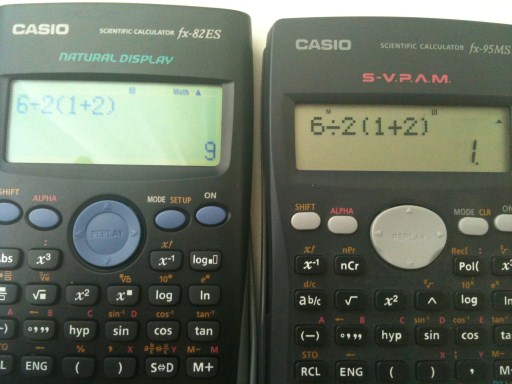
Mnemonics are often used to help students remember the rules, but the rules taught by the use of acronyms can be misleading. In the United States the acronym PEMDAS is common. It stands for Parentheses, Exponents, Multiplication, Division, Addition, Subtraction. If PEMDAS is followed without remembering that multiplication and division have the same weight, and addition and subtraction have the same weight. Doing multiplication before division, can give the wrong answer. So can doing addition before subtraction. Some grade school books teach this incorrectly. For example: 6÷2×3 = 9, not 1. 6-2+3 = 7, not 1.
In other English speaking countries, Parentheses may be called Brackets, or symbols of inclusion and Exponentiation may be called either Indices, Powers or Orders, and since multiplication and division are of equal precedence, M and D are often interchanged, leading to such acronyms as BEDMAS, BIMDAS, BODMAS, BOMDAS, BERDMAS, PERDMAS, PEMDAS, and BPODMAS.
These mnemonics may be misleading, especially if the user is not aware that multiplication and division are of equal precedence, as are addition and subtraction. Using any of the above rules in the order "addition first, subtraction afterward" would also give the wrong answer.
The correct answer is 9, which is best understood by thinking of the problem as the sum of positive ten, negative three, and positive two.